Henry Chesbrough describes a new paradigm of open innovation that is in
contrast to the traditional closed model. To understand open
innovation, it is worthwhile to review the older model of closed
innovation.
The Closed Innovation Model
Under the concept of
innovation that prevailed during most of the 20th century, companies
attained competitive advantage by funding large research laboratories
that developed technologies that formed the basis of new products that
commanded high profit margins that then could be plowed back into
research. This vertical integration of the research function meant that
firms that could not afford such research were at a disadvantage. The
vertically integrated concept of the research and development pipeline
is depicted in the following diagram:
Closed Innovation Concept

In the above diagram, the red
lines represent completed research projects, some of which may have
resulted in patents, but that never made it to development. This often
is the situation if the innovation is not useful to the company's core
business. Such completed research projects often are shelved until a
market opportunity arises to use them, if such an opportunity arises at
all.
Chesbrough observed that this
closed model began to change in the 1990's, when firms such as Cisco
Systems competed very effectively with research-endowed companies such
as Lucent Technologies (which inherited most of Bell Labs).
Erosion of the Closed Innovation Paradigm
There now are many famous
cases in which companies have developed disruptive technologies but
have nonetheless failed to capitalize on them. One reason for failure
is that managers often wrongly assume that just because customers are
fascinated by an innovation, there also exists a corresponding business
model. Henry Chesbrough used the Xerox Palo Alto Research Center (PARC)
as an example. The research from PARC spawned many successful products,
but the shareholders of Xerox did not benefit as much as others did.
Employees who worked on promising technologies departed to form
start-up companies, many of which, such as 3Com and Adobe, acheived
much success. In fact, the market capitalization of Xerox's spin-offs
exceeded that of Xerox itself.
The Xerox PARC example raises questions about the viability of the closed innovation model going forward in the 21st century. According to Chesbrough, the closed innovation paradigm has eroded due to the following factors:
- Increased mobility of skilled workers
- Expansion of venture capital
- External options for unused technologies
- Increased availability of highly-capable outsourcing partners
Open Innovation Paradigm
Rather than being held closely
within the firm, under the concept of open innovation research results
are able to traverse the firm's boundaries. Other companies that are
able to utilize a technology can license it, creating a win-win
situation. Similarly, the firm may be able to license the technologies
created by other firms. This concept of open innovation is illustrated
in the following diagram:
Open Innovation Concept
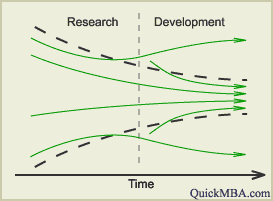
This diagram uses
dashed lines to illustrate that the boundaries of the firm are porous.
The lines exiting the firm represent technologies that are licensed to
other firms and that otherwise would have gone unutilized (they were
the red lines in the closed innovation diagram). The lines entering the
firm represent outside technologies that are licensed to the firm.
These are technologies that did not originate in the firm's own
research laboratories but nonetheless are useful in the firm's core
business.
Internal Ventures
Established companies often
view entrepreneurs and the venture capitalists who fund them as a
threat. Chesbrough argues that they should be viewed as laboratories
that test market real products to real customers. In a dynamic
entrepreneurial economy, such information can be more useful than more
hypothetical marketing research. Some large firms have taken the open
innovation model further by forming alliances with start-ups or even
acquiring them. The more progressive firms have formed their own
internal venture groups to power their own innovation process.
Operating an internal new ventures group provides the firm with the following benefits:
It allows the monetization of technologies that otherwise would go unused in the firm's own business.
The venture process brings the technologies to market quicker.
It provides valuable feedback by applying the technology to different uses in different markets.
When there is innovation in the business model itself, a ventures group is a tool for rapidly protoyping new business models.
Business Model for Innovation
Technology only has value when
it is commercialized by means of a business model. The dot-com boom and
bust illustrates this concept well, as there was much innovation but
relatively few business models that could capture the potential value
of the new technologies. According to Chesbrough, a firm can capture
value from an innovation in the following three ways:
- Using the technology in its existing business
- Licensing the technology to other firms
- Launching a new venture that uses the technology
Given the complexities of
products, markets, and the environment in which the firm operates, very
few individuals, if any, fully understand the organization's tasks in
their entirety. The business model serves to connect the
entrepreneurial inputs to the economic outputs.
Intellectual Property and Open Innovation
In the historical model of
vertically integrated research, new technologies were used in the
firm's core business. Other potential uses of the technology did not
unfold.
Under the model of open
innovation, the same intellectual property can be applied to different
markets. The firm creating the IP may license it to one firm for use in
one market, and other firms for use in their respected markets.
Chesbrough used Millennium
Pharmaceuticals as an example of a young company that built its
business model around the concept of open innovation for the licensing
of intellectual property. Millennium supplies information and analysis
of biological compounds useful to large pharmaceutical firms in drug
development.
Previous business models for
such firms involved contracting the services. Those firms are known as
contract research organizations, and they essentially performed the
work on a contract basis with the pharmaceutical firms owning the
resulting intellectual property. Two disadvantages of this model are:
the potential value of the intellectual property would not be
unlocked since it would be confined to the market of the pharmaceutical
firm paying for the services, andthe growth of such a pay-per-service firm is somewhat limited since there are few economies of scale.
Millennium Pharmaceuticals
developed a business model whereby Millennium retained ownership of the
IP that it developed and licensed the IP to the larger pharmaceuticals.
Exclusivity was given for specific markets, but each biological target
that resulted could be licensed to different firms for use in different
markets, with exclusivity given for each market. The full potential
value of the IP could be unleashed since it would not be hoarded for
use in the core business of one firm. This model created a win-win
situation whereby the potential value of the IP was distributed to both
Millennium and the pharmaceuticals as follows:
Millennium retained ownership of the IP and therefore could generate
additional revenue by licensing it to other firms for use in other
markets.The large pharmaceutical firms gained the intellectual property they
needed at a cost lower than they would have incurred had they acquired
complete ownership of it.
The example of Millennium
Pharmaceuticals illustrates both the benefits of open innovation and
the importance of the business model in unleashing value.

No comments:
Post a Comment