Friday, May 26, 2006

Yahoo Makes Deal on Ads With eBay


Yahoo Makes Deal on Ads With eBay


Published: May 26, 2006


EBay and Yahoo, two top Internet companies that have been losing ground to Google, said yesterday that they would work together in several areas, including advertising and online payments.


The deal will expand Yahoo's share of Internet advertising, a market where it lost leadership to Google. Investors have been worried that eBay's highly profitable shopping site is being undercut as consumers increasingly find products through search engines or through free listing services like Craigslist. Google and Yahoo have introduced similar free services.


At the same time, eBay is spending $260 million a year to advertise its auctions on search engines, with 60 percent of that on Google, according to estimates by Jordan Rohan, an analyst with RBC Capital Markets.


The deal announced yesterday gives eBay some new ways to make money from its large audience, but it does not directly address the concerns about competition. Yahoo will continue to offer its auctions and other online shopping services that compete directly with eBay.


The Yahoo-eBay agreement came as Google announced that it had reached a deal to put its software on Dell computers. [Page C3.]


For Yahoo, the deal with eBay represents a potentially significant expansion of its advertising business. EBay agreed to place on its site text advertisements sold by Yahoo. That gives Yahoo a major new partner just as the MSN service of Microsoft, which was the largest outlet for Yahoo's text ads, has switched to selling its own advertising.


Small text ads that automatically appear next to related material on Web pages have proved hugely profitable, but eBay has long been wary of placing them on its site because they are likely to refer people to sites that compete with its marketplace.


"EBay is selling a little bit of its soul by doing this deal," Mr. Rohan said. "The idea of eBay as a destination site is marginalized by a deal that drives traffic outside of eBay."


Margaret C. Whitman, eBay's chief executive, said the company was starting to change its policy because "we have to embrace some of the things that are happening on the Web." Still, she said, the company will test the impact of the text ads to make sure they do not hurt revenue.


Ms. Whitman added that the text ads would be restricted so they did not offer products that competed directly with eBay's sellers. They will be for "complementary products" like cases for digital cameras, she said, and they will also appear when a user searches for a product that is not available on eBay.


EBay also agreed to have Yahoo sell graphical display advertising on its site, the first time Yahoo has sold graphic ads for another company.


"EBay brings the best of quality inventory and a huge community," said Terry S. Semel, Yahoo's chief executive.


Yahoo and eBay said the revenue from the deal would be small this year, and they declined to characterize its financial impact for next year. Mr. Rohan said that if eBay placed text ads on 25 percent of its pages, the revenue could be about $130 million a year, and about 80 percent of that would go to eBay.


Mr. Rohan said the deal might help establish Yahoo as an advertising network that is an alternative to Google.


Microsoft has been trying to establish its advertising network and is reported to have bid for eBay's business. Google, which is by far the leader in selling text ads for other Web sites, has been moving to sell graphic ads as well, and said this week that it would start selling video advertisements for other sites.


Google's approach is to create an automated auction in which marketers enter their own advertisements and bid for placement. Yahoo, which uses such an auction for text ads, will sell graphic ads on eBay through its traditional sales force, which negotiates rates with major marketers.


EBay will also offer its customers a new version of its browser toolbar that will encourage people to use Yahoo search and other services. Yahoo agreed to offer eBay's PayPal payment service as an option for customers buying goods and services through Yahoo's site.


The companies said they would explore developing features that would let people click on ads on either of their sites and be connected with the advertiser through either eBay's Skype voice chat service or the voice calling feature of Yahoo Messenger.


EBay's shares rose to $33.88, up $3.68. Yahoo rose $1.13 to $32.92


Ms. Whitman said the deal did not mean eBay would cut back its huge spending on Google advertisements. Search and other advertising brings in about 40 percent of eBay's traffic.


She said she did not see the competition from search engines and free classified sites as undercutting eBay's position with consumers.


"There is a lot more to running a marketplace than getting a lot of listings," she said. "There is trust and safety, and payments and reputation. That stands eBay in good stead."

Friday, May 19, 2006

NYT: Microsoft and Google Grapple for Supremacy


Microsoft and Google Grapple for Supremacy


Dan Acker/Bloomberg News

Bill Gates, left, chairman of Microsoft, and Eric Schmidt, Google's chief, find their companies battling over technology and talent.


Published: May 10, 2006


The Microsoft- Google rivalry is shaping up as a titanic corporate clash for the ages.


It may not turn out that way. Markets and corporate fortunes routinely defy prediction. But it sure looks as if the two companies are on a collision course, as the realms of desktop computing and Internet services and software overlap more and more.


Microsoft, of course, is the reigning powerhouse of computing and Google is the muscular Internet challenger. On each side, the battalions are arrayed: executives, engineers, marketers, lawyers and lobbyists. The spending and competition are escalating daily. For each, it seems, the other passes what Andrew S. Grove, a founder and former chairman of Intel, calls the "silver bullet test" of strategic competition. "If you had one bullet, who would you shoot with it?"


How the Microsoft-Google confrontation plays out could shape the future of competition in computing and how people use information technology.


Do the pitched corporate battles of the past shed any light on how this one might turn out?


Business historians and management experts say the experience in two of the defining industries of the 20th century, mass-market retailing and automobiles, may well be instructive. The winners certainly scored higher in the generic virtues of business management: innovation, execution and leadership.


But perhaps even more significant, those who came out on top, judging from history, had two more specific attributes. They were the companies, according to business historians, that proved able to adapt to change instead of being prisoners of past success. And in their glory days, these corporate champions were magnets for the best and brightest people.


"One area where Microsoft and Google are really competing head-to-head now is in the war for talent," said Richard S. Tedlow, a historian and professor at the Harvard Business School. "Historically, the company that won the war for talent, won the war."


Mr. Tedlow points to Montgomery Ward as a company that lost talented managers to its rival Sears, and then lost its way. The crucial defection, Mr. Tedlow said, was Robert E. Wood, a former Army general who joined Montgomery Ward in 1919 as a general merchandise manager.


Even in the Army, Mr. Wood was a close reader of the Statistical Abstract of the United States, the Census Bureau's annual tracking of social and economic conditions. Mr. Wood became convinced that America was at the beginning of a huge population shift from rural regions to urban areas.


That meant, he understood, that the mail-order giants like Montgomery Ward and Sears needed to move from being catalog retailers serving a dispersed market to department store merchants with stores in city and suburban population centers.


Sears, as a company, grasped that fundamental change in the marketplace in a way that initially Montgomery Ward did not, Mr. Tedlow said.


In 1924, Mr. Wood left Montgomery Ward to join Sears, and he later recruited others. In 1945, Mr. Wood, then the chairman of Sears, made another smart call on economic trends. The postwar years, he decided, would bring a long expansion, as pent-up consumer demand from the war years was unleashed.


So Sears embarked on a national store-building binge. His counterpart at Montgomery Ward, Sewell Avery, made the opposite bet, keeping money in the bank to prepare the company for a postwar depression, which he was convinced was around the corner.


Over the next several years, sales at Sears doubled, while Montgomery Ward's shrank 10 percent. "Losing Robert Wood was catastrophic to Ward," Mr. Tedlow observed.


In its recruiting face-offs against Google, Microsoft insists that it fares quite well over all. But there have been some high-profile defections of leading engineers, who said they preferred Google's technological direction and corporate culture.


The most prominent was Kai-Fu Lee, a stellar computer scientist and manager. Mr. Lee not only established Microsoft's research labs in China, but he is also an expert in areas like natural language and speech-recognition technologies — important ingredients to Internet search today and to the way people will interact with computers in the future.


Last year, when Mr. Lee left Microsoft, it sued Google and Mr. Lee. Microsoft claimed, under a Washington state law, that Mr. Lee violated a noncompete clause in his employment contract and misused inside information in going to work for Google. The suit was settled last December.


"What does it say about a company when it sues when someone leaves?" Mr. Tedlow asked. "It makes Microsoft sound like a prison."


In business, forever tends to last about five years, a decade or two at most. So Sears prospered for a time and celebrated its success by building the Sears Tower in Chicago in the 1970's. Yet even from a height of 110 stories, Sears failed to see Wal-Mart coming. Wal-Mart brought the next revolution in retailing with its shrewd use of computer technology to track buying trends and orchestrate suppliers to become a hyper-efficient, low-cost merchant.

Thursday, May 18, 2006

Amazon's "electronic soul mate"

ZT from money.com


"Analysts also have expressed concerns that Amazon.com
is spending a lot on technology while refusing to disclose in detail
what the spending is for. Bezoson Monday mentioned at least one
far-flung technological innovation that has been discussed around the
office - though perhaps not seriously: the "electronic soul mate."

Bezos said the idea is to pair users with the other Amazon.com customer whohas the most similar purchasing history.


After playing matchmaker, the company also would try to squeeze out an
extrapurchase, noting what five books your "soul mate" has purchased
but you haven't."

Tuesday, May 16, 2006

clause of the day: Brownie point


Brownie point


NOUN:An amount of credit considered as earned, especially by favorably impressing a superior. Often used in the plural.
ETYMOLOGY:From the practice of awarding points for achievement to Brownies in the Girl Scouts.

Monday, May 15, 2006

说曹操,曹操到

刚说道道貌岸的伪君子,就看到了南怀谨。


这斯凭借古文今译,大发其财。


新浪的blog,终于看到他如下鲜为人知的作为。


[匿名] ane


2006-03-04 09:47:43

感觉看南怀瑾的最大无味是整篇充斥着“我说……”这样的权威霸道。他的学识确实宽广,但他的见识却不包容。他带人进门,但很多人容易被引入他见解的那条道,他的文章缺少的是提供思维鼓励继续促进深入研究的气量。
喜欢朱老师的博,如果不是这篇,还不会回头思考我为什么看了南怀瑾的文章后总有反感。


2006-03-04 12:19:43

读书当然要有自己的判断。个人以为南怀谨对论语的解读还是不错的。


[匿名] 大不拘


2006-03-04 16:15:32

其实南先生对于大多数的读者而言,是成也萧何,败也萧何。
伊在这个浮光掠影般配的社会提出来,要有作古人,士大夫的情怀,以一个道德教化者的身份出现。只差说,逝者如斯夫了。这本是有号召力的,只是,当他自己离妻再娶,甚至是因子而婚时,读者,或是他的说从者们自是不答应。不是纠缠于他的私生活。而是凡人觉得,一个他这样的人怎么能动凡心,动了凡心还高高在上地俯视我们。不是读者要求太多,普通人,谁去管你学术上的造诣?一味地追名逐利罢了。不是我们浅薄,你当真想坦腹东床,也没泰山大人尝识你啊。

Sunday, May 14, 2006

万花筒

透过多棱镜的反射,万花筒在小小的空间里创造着一个奇妙的世界。

但是当你开始研究它的结构,一切都只是一堆碎纸片,或者顶多是一个包裹着漂亮的小石子的玻璃壳而已。

所以无论是如何包装的道貌岸然的人,也不过是欲望的机器。

母亲节的来历(转载)


 关于母亲节的来源,有历史学家声称最早可能是在古希腊,人们庆祝“莉雅”女神的节日。这个女神就是宙斯的母亲。


    但是到了十七世纪的英国,教会把庆祝“莉雅”女神的节日改为表达对耶稣之母马利亚的崇敬,订四旬斋的第四个星期日为 Mothering Sunday。甚至后来人们加入教会的受洗仪式都订在母亲节这一天。象征人们从教会(Mother Church)重生(rebirth)。

      
另外还有一个关于英国母亲节的传说。那时许多穷人,叫孩子去有钱人家帮佣,住在主人家里。直到 Mothering Sunday这一天,主人们会放他们假,让大家可以返家与母亲团聚。那天这些年轻人就会带着一种特别的蛋糕(mothering cake),与一些小礼物送给母亲。


在美国,母亲节后来也成为安慰在战争中失去儿子或先生的女性的节日。在当天,人们配戴康乃馨向母亲致敬。母亲若尚健在者,佩带红色康乃馨;若母亲已过世,则佩带白色,以表示怀念。


在美国,以写《共和国战歌》而闻名的女作家朱莉亚·瓦德·霍耶(Julia Ward Howe),曾建议在六月中选定某一天为“母亲节”。由于美国内战的爆发,许多母亲感受到战争的恐怖,及失去爱子的痛苦,朱莉亚极力鼓吹订一个节日以提倡和平。她的建议只被少数几个地方采纳了。


一九○七年,一位叫做Ana Jarvis的美国妇女写信给格拉夫顿教堂的牧师,请他为已逝世两周年的妈妈做个特别的追思礼拜。当天,Ana捐赠了五百朵妈妈生前最喜欢的花─白色的康乃馨,送给所有参加仪式的小孩和母亲。


第二年,教堂便正式宣布,Ana Jarvis母亲逝世的三周年忌日为母亲节。但是当天Jarvis却没有出席,因为她正在费城忙着组织一个母亲节委员会。 在这个委员会的协助下,安娜开始发动大规模的写信运动。她写信给数以百计的教堂、商业领袖、报纸编辑、政治家等,要求他们加入制定母亲节为国定假日的活动。


一九一○年,西维吉尼亚州州长响应了她的请求,并发表第一个母亲节的宣言,要求所有的西维吉尼亚人,在五月的第二个星期日,佩带白色的康乃馨上教堂。而俄克拉荷马州及华盛顿州,也在那一年开始庆祝母亲节。到一九一一年,母亲节的礼拜活动便在全美各州举行。


       Ana Jarvis
的努力,终于在一九一四年的五月八日开花结果,因为国会通过一项联合决议,要求美国人在那一年五月的第二个星期日悬挂国旗,以表达对全美国母亲无比的尊敬和爱意。第二天早上,安娜成为美国白宫的客人,亲眼看着威尔逊总统签署这项决议。


     五月,一个美丽如花的季节,因为一个特殊的节日,而将它点缀得更加多姿多彩,那就是母亲节。

Thursday, May 11, 2006

Complexity

When I started looking at the gateway to high society. http://www.conference.committee100.org/mentorprogram.html
http://mtjade.org/public/mentorship/

I just can't help wondering, are they for real? Or are they just paranoid that the web is going to flattern everything that they can't keep their current standing anymore. One thing I am sure is that somebody is willing to put up a fight to squeeze into these 100 people committee.
Everything is power, everything is political. And human can't help but playing the game.

life happens

KQED pledge drive this week is driving me crazy.


Did a one-on-one with Peter, the new CEO, and he said my suggestion of doing document imagery made his day.


Did a teleconf with Jun Miyasaki, who told us document imagery is the core business of FX. Lynn wasn't aware of that and I am surprised.


Greg Huang comes to town to promote his new book on Guanxi. I got his book the day after.

Sunday, May 7, 2006

ZT 诸葛亮: 诫子书


诸葛亮: 诫子书

夫君子之行,

靜以修身,

儉以養德;

非澹泊無以明志,

非寧靜無以致遠。

夫學須靜也,

才須學也;

非學無以廣才,

非志無以成學。

怠慢則不能勵精,

險躁則不能冶性。

年與時馳,

意與歲去,

遂成枯落,

多不接世。

悲守窮廬,

將復何及!

Friday, May 5, 2006

ZT 德川家康


t1.gif (5734 個位元組)


  今年初(民77),「遠流出版公司」出版了一本《帝王書》,該書由當今日本文史界的精英屋太一、白石一郎、齊藤榮等人從「謀略」的觀點,對德川家康如何取的天下作了徹底的分析。是世人想了解「德川家康」這個人,認識「日本民族」的民族性,所不可不讀的一本好書。


  而這本《商用德川家康兵法》則從「戰史」和「兵法」的角度,以家康參與的主要戰役貫穿全文,詳細分析在不同階段中,他爭天下,奪霸主所採取的戰術、謀略,及其成敗勝負的道理。在閱讀的過程中,我們不妨將德川家康一生在不同階段採取的生存之道,以之參照我們個人的榮枯順逆,或一家企業的成敗興衰,甚至一項產品的強弱起落,則不但可以獲得更多的啟示,而且可以從中體悟成功與失敗的道理。若果如此,則在戰史和兵法之外,我們必然有意想不到的領會和頓悟。


  在本書中,德川家康的一生大致被作者劃分為「弱」、「由弱轉強」和「強」三個階段。這三個不同的階段,家康是如何求生存、謀發展、圖壯大,其關鍵性的因素何在?其法則將之運用在企業的經營管理或商戰中,又具有什麼樣的意義和價值呢?茲將筆者歸納出的淺見,簡述如下:


階段1 處於弱勢


  德川本為三河小國,夾在東西的今川及織田兩大強國之間。在國際上,這種弱國的命運必然是悲慘的,即使想盡辦法去依附一個強國的保護,也得不到絕對的平等和尊重。所以,這一求生存階段所需要的是「認知力」,也就是充分的認識本身所處的地位和條件。


德川家康的簽名字跡  家康對於自己的處境知之甚深,為了突破這種困境,他所採取的策略是「生存第一」的亂世生存術,主要的原則是置之死地而後生的攻勢戰略,即使是充當盾牌或砲灰也在所不惜。他選擇依附一個強國,盡力在混戰中求表現。這是夾縫中求生存、開活路,化危機為轉機唯一的方法。


  他的這種策略,不但贏得強國的看重和尊敬,而且也藉此鍛鍊德川軍的戰力。在桶狹間、越前、川戰役中,他都充當第一線,擔任最危險的前鋒,抱必死的決心奮勇作戰,結果反而在危機的極限處找到勝利的契機。德川的地位因這幾場戰役中非凡的表現而漸漸受到肯定。


  處在弱者階段的家康,他的生存之道,簡單的說,就是無條件的承認自己實力的弱小。因此,在政治上的姿態極為低姿。然而,在戰場上他了解到退一步無死所,所以只好「有進無退,以賭命的方式脫穎而出,因此奠定了日後發展的基礎。所以,家康的「認知力」是使他能忍辱負重,否極泰來主要的原因。


  德川家康的弱者生存法則,對企業的經營來說,有許多原則都是足供參借鏡的。尤其是市場地位在同業中處在第三位以後的弱勢企業,或由於企業或商品的知名度太低,或由於市場佔有率不高,或由於行銷的資源、人才不足等等。不管任何理由,此時行銷的策略亦只宜採「生存第一」的原則,充分認知本身的實力和不利的地位,絕對不能採取和市場佔有率第一、第二位或高知名度品牌者硬碰硬的正規戰,而要採游擊戰、騷擾戰,以韌性和忍性發揮戰力。與其發動一個全國性的行銷活動,不如在地方性的市場或進可攻退可守的城鎮取得絕對的優勢。如此攻城掠地、打帶跑的戰術,雖然辛苦,但累積的戰果必大。試看家康在統一天下霸權的過程,幾乎長達六十年,其間忍受了多少因兵力、國力不如人的委屈和辛酸,即可知霸業之取得不易。


階段2 由弱轉強的階段


  如果家康在弱者階段所依賴以生存的是「認知力」,則在由弱轉強的階段,最重要的是「意志力」、「判斷力」和「組織力」。


  由於在三方原之戰中,德川曾吃過敗仗,使他深深了解到「有勇無謀」的危險。他也體會出不遵守兵法的亂仗硬挺是不足以成大事的,自己如果有志於「進出京都,號令天下」,就不需改變戰略。


  所以,在這個階段,家康所重視的是聯盟的選擇。和誰聯盟最有利?如何聯強制弱?而不再是無條件、命令式的依附強者。而在每場戰役出戰前,總會深思何者應該應戰?何者不應戰?何時該採持久戰?何時該用消耗戰?這些問題的決定,都需要睿智明確的「意志力」和「判斷力」。例如:在高天神城爭奪戰中,他就能堅定的避開挑戰的誘惑而按兵不動,藉以消耗武田勝賴的戰力。而在長篠城攻防戰中,他為了威信,即使犧牲再大,他也義無反顧的參與。這種果斷和毅力,是他能由弱轉強的關鍵。


  此外,他在諸多聯盟和戰役中,深感參謀作業與企劃幕僚的重要,而開始精心培養智囊團。像政治參謀本多正信、情報參謀服部半藏、戰略參謀內藤信成、高木清秀等人,都是在這段期間培養出來的。這些幹部使德川兵團形成一個布局沈穩,有計畫、有組織、有效率的「常山之蛇」,對他後來打敗石田三成,掃除反對勢力掌握大權有極多的貢獻。


  從德川家康由弱轉強的過程來看,他等於是中小企業要脫胎換骨,擠身於大企業的前奏。亦即市場地位第三位以後的企業準備要竄升到第二位,此種轉化蛻變的過程,是十分艱難且痛苦的工程。其間最主要的關鍵即在於經營者的「意志力」、「判斷力」和「組織力」。遠有企業的體質和結構要徹底的整頓改變,家族企業的窠臼和羈絆要加以擺脫,這種包袱,除非具有堅定的意念與決心,否則決難奏功。對企業未來的發展,長期經營得方針和策略的擬定,則需要敏銳果敢的判斷力。因此,制度的規劃、人才的網羅、財物的安全、幕僚的建立等等,都要在這個階段做好安排和準備。


階段3 強者的地位


  使德川家康真正成為強者的關鍵性戰役是小牧‧長久手之戰。這兩戰之後,他等於取得了與最大強敵豐臣秀吉分庭抗禮的機會。不過,在武田和織田軍長期的苦戰中,他已開始由「戰略」轉而注重「謀略」,也從組織戰中發現「統率力」的重要性。


  「謀略」即智慧之意,亦即不再以能戰、善戰作為解決敵我之間問題的方法,而改以兵法中最高境界的「不戰而勝」來達成自己的目標。即使非戰不可,也要讓敵人主動開戰,以求得道德和大義上的美譽,作為收服人心的張本。像關原之戰、大阪之役,都是他不得已才應戰,而且每一戰必以政治上的謀略取勝。


  至於「統率力」的強化,則是知人善任,充分運用幕僚參謀的專業才能,是組織的戰力得到充分的發揮,並藉將帥的人格、神格感召部屬的凝聚與向心,協同一致的理想的目標邁進。這是他最後能以臣屬的身份擊敗豐臣氏的最主要原因。


  經過「弱」、「由弱轉強」到「強」這三個階段的企業,等於是取得業界盟主的地位。這個階段的經營管理,亦可師法德川家康的強者兵法,致力於「謀略」的運用,以及「統率力」的強化。因為,處於強勢或第一品牌的企業,規模必然相當龐大,產品種類亦不斷增加,經營者事實上不可能事必躬親,鉅細靡遺的照顧。因此,就要懂得授權和分層負責的專業分工,充分發揮組織的功能。在商戰方面則要施展合縱連橫,遠交近攻的謀略,致力於市場的擴大;對於競爭者可用以大吃小或大小通吃的策略,或兼併、或消滅,才能鞏固第一的市場地位,維持霸主的局面於不墜。


  以上分析了德川家康三階段的兵法及其在企業管理上的應用之後,我們也不能忽略了家康成功非常重要的一項性格:「忍人之所不能忍」的功夫。此一性格不論在任何階段,都表現得令人感到他的不凡:從弱者時代充當金川義元的先鋒砲灰開始,到被織田信長利用來攻打越前,被下令殺子殺妻,向豐成秀吉稱臣等等,都發揮了他的「忍術」,由於他能「忍人之所不能忍」,無怪乎他能「成人之所不能成」。


  另外,就是他善於模仿的本領,我們也不能不有所認識。他曾埋首研究甲州軍學及武田的用人知道,也從織田處學到新的戰術戰略,以及管理財政經濟的方法。他的善於模仿,對於後來日本傳統精神及國民性有著極大的影響。


  當然,德川家康亦非毫無缺陷或永不犯錯的完人,不過,他卻有錯而不再犯,且從錯誤中汲取教訓成為智慧的天賦。像三方原之戰,他就因驕矜自滿,不尊兵法而大敗,然而,這次失敗之後,他終身再也沒有重蹈覆轍,反而因之而由弱轉強。


  在書中,我們也可以領略到日本戰國時代諸侯間的爾虞我詐、分分合合,以及各種強凌弱、眾暴寡的陰謀詭計,像「三十六計」中的苦肉計、離間計,「孫子兵法」中的重要觀念、戰略法則等等,將支用於商戰之中,都能產生一定的用途。


  因此,閱讀本書,不但可以提綱挈領的掌握日本戰國時代重要的史實和戰役,亦可了解德川家康奮鬥的過程和成功之道,並且將其重要的原則運用在企業的經營管理和商戰上。讀一本能有如此多方面的收穫。無論如何都是值得的。(本文取自《商用德川家康兵法》)

Thursday, May 4, 2006

Open Innovation (ZT)

Innovation and entrepreneurship are at the heart of "creative destruction". In his book, Open Innovation,
Henry Chesbrough describes a new paradigm of open innovation that is in
contrast to the traditional closed model. To understand open
innovation, it is worthwhile to review the older model of closed
innovation.

The Closed Innovation Model


Under the concept of
innovation that prevailed during most of the 20th century, companies
attained competitive advantage by funding large research laboratories
that developed technologies that formed the basis of new products that
commanded high profit margins that then could be plowed back into
research. This vertical integration of the research function meant that
firms that could not afford such research were at a disadvantage. The
vertically integrated concept of the research and development pipeline
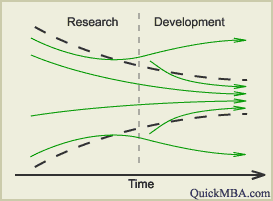
is depicted in the following diagram:


Closed Innovation Concept


In the above diagram, the red
lines represent completed research projects, some of which may have
resulted in patents, but that never made it to development. This often
is the situation if the innovation is not useful to the company's core
business. Such completed research projects often are shelved until a
market opportunity arises to use them, if such an opportunity arises at
all.


Chesbrough observed that this
closed model began to change in the 1990's, when firms such as Cisco
Systems competed very effectively with research-endowed companies such
as Lucent Technologies (which inherited most of Bell Labs).


Erosion of the Closed Innovation Paradigm


There now are many famous
cases in which companies have developed disruptive technologies but
have nonetheless failed to capitalize on them. One reason for failure
is that managers often wrongly assume that just because customers are
fascinated by an innovation, there also exists a corresponding business
model. Henry Chesbrough used the Xerox Palo Alto Research Center (PARC)
as an example. The research from PARC spawned many successful products,
but the shareholders of Xerox did not benefit as much as others did.
Employees who worked on promising technologies departed to form
start-up companies, many of which, such as 3Com and Adobe, acheived
much success. In fact, the market capitalization of Xerox's spin-offs
exceeded that of Xerox itself.


The Xerox PARC example raises questions about the viability of the closed innovation model going forward in the 21st century. According to Chesbrough, the closed innovation paradigm has eroded due to the following factors:


  1. Increased mobility of skilled workers
  2. Expansion of venture capital
  3. External options for unused technologies
  4. Increased availability of highly-capable outsourcing partners

Open Innovation Paradigm


Rather than being held closely
within the firm, under the concept of open innovation research results
are able to traverse the firm's boundaries. Other companies that are
able to utilize a technology can license it, creating a win-win
situation. Similarly, the firm may be able to license the technologies
created by other firms. This concept of open innovation is illustrated
in the following diagram:


Open Innovation Concept


This diagram uses
dashed lines to illustrate that the boundaries of the firm are porous.
The lines exiting the firm represent technologies that are licensed to
other firms and that otherwise would have gone unutilized (they were
the red lines in the closed innovation diagram). The lines entering the
firm represent outside technologies that are licensed to the firm.
These are technologies that did not originate in the firm's own
research laboratories but nonetheless are useful in the firm's core
business.


Internal Ventures


Established companies often
view entrepreneurs and the venture capitalists who fund them as a
threat. Chesbrough argues that they should be viewed as laboratories
that test market real products to real customers. In a dynamic
entrepreneurial economy, such information can be more useful than more
hypothetical marketing research. Some large firms have taken the open
innovation model further by forming alliances with start-ups or even
acquiring them. The more progressive firms have formed their own
internal venture groups to power their own innovation process.


Operating an internal new ventures group provides the firm with the following benefits:


  • It allows the monetization of technologies that otherwise would go unused in the firm's own business.


  • The venture process brings the technologies to market quicker.


  • It provides valuable feedback by applying the technology to different uses in different markets.


When there is innovation in the business model itself, a ventures group is a tool for rapidly protoyping new business models.


Business Model for Innovation


Technology only has value when
it is commercialized by means of a business model. The dot-com boom and
bust illustrates this concept well, as there was much innovation but
relatively few business models that could capture the potential value
of the new technologies. According to Chesbrough, a firm can capture
value from an innovation in the following three ways:


  • Using the technology in its existing business
  • Licensing the technology to other firms
  • Launching a new venture that uses the technology

Given the complexities of
products, markets, and the environment in which the firm operates, very
few individuals, if any, fully understand the organization's tasks in
their entirety. The business model serves to connect the
entrepreneurial inputs to the economic outputs.


Intellectual Property and Open Innovation


In the historical model of
vertically integrated research, new technologies were used in the
firm's core business. Other potential uses of the technology did not
unfold.


Under the model of open
innovation, the same intellectual property can be applied to different
markets. The firm creating the IP may license it to one firm for use in
one market, and other firms for use in their respected markets.


Chesbrough used Millennium
Pharmaceuticals as an example of a young company that built its
business model around the concept of open innovation for the licensing
of intellectual property. Millennium supplies information and analysis
of biological compounds useful to large pharmaceutical firms in drug
development.


Previous business models for
such firms involved contracting the services. Those firms are known as
contract research organizations, and they essentially performed the
work on a contract basis with the pharmaceutical firms owning the
resulting intellectual property. Two disadvantages of this model are:


  1. the potential value of the intellectual property would not be
    unlocked since it would be confined to the market of the pharmaceutical
    firm paying for the services, and


  2. the growth of such a pay-per-service firm is somewhat limited since there are few economies of scale.


Millennium Pharmaceuticals
developed a business model whereby Millennium retained ownership of the
IP that it developed and licensed the IP to the larger pharmaceuticals.
Exclusivity was given for specific markets, but each biological target
that resulted could be licensed to different firms for use in different
markets, with exclusivity given for each market. The full potential
value of the IP could be unleashed since it would not be hoarded for
use in the core business of one firm. This model created a win-win
situation whereby the potential value of the IP was distributed to both
Millennium and the pharmaceuticals as follows:


  • Millennium retained ownership of the IP and therefore could generate
    additional revenue by licensing it to other firms for use in other
    markets.


  • The large pharmaceutical firms gained the intellectual property they
    needed at a cost lower than they would have incurred had they acquired
    complete ownership of it.


The example of Millennium
Pharmaceuticals illustrates both the benefits of open innovation and
the importance of the business model in unleashing value.

Wednesday, May 3, 2006

2099是什么意思


今天突然想到这个msn随机指定的nickname似乎应该有某种意义。就像其他suggested nickname一样,它要么是你的生日,要么是你的lastname. 世界上没有纯粹的偶然,一切偶然的背后都有冥冥中的定数。


那么2099又是什么意思呢?在阳光明媚的年轻的时光里,我冥思苦想,不得其解。那将是我生命的终点。这个念头令我不寒而栗。

即使科学真有奇迹,我也活不到2099。What I do between now and 2099 is my entire life. Nothing exists afterwards, because even if it does, it won't make any difference to me.


Maybe that's why people take all the trouble to bring up their children, to prolong their existence in this world.